Vermilion Field Instrument with Integrated Illumination and Tethering Mechanism
Provenance Formerly in the collection of the late Dr. Aris Thorne, a private enthusiast of kinetic micro-tools, acquired in Geneva circa 2004. It subsequently passed through the estate of the Vane Estate in Sussex, following the deaccession of a related lot in 2011. The donor, a distant cousin, provided no further details regarding its intermediate custodians.
Period Circa Early Twenty-First Century, attributed to the Altdorf Workshop Tradition
Interpretation This ensemble exemplifies the late-twentieth-century obsession with modular utility and the blurring of domestic and professional boundaries, as seen in Accession No. 3. The vermilion polycarbonate sheath suggests a high-visibility aesthetic choice, prioritizing retrieval over concealment—a stark departure from the silent lethality of earlier cutlery traditions. The integration of the photonic element alongside the cutting blade indicates a user base demanding immediate environmental awareness alongside physical intervention. The inclusion of the tension-clip tether reveals a profound anxiety regarding loss, a psychological marker of the digital age where physical anchors are increasingly scarce. The object functions not merely as a tool, but as a talisman of self-sufficiency, a portable assertion of control over chaotic environments.
Condition Minor pitting on the primary blade pivot. The clear photonic housing exhibits significant micro-scratching consistent with high-velocity friction against metallic fasteners. The black polymer tether shows signs of abrasion at the stress points, though the structural integrity remains uncompromised. Faint adhesive residue remains on the handle surface.
Accessioned 25 August 2026
The Curator's private notes
Recovered from the margin of the working file. Not for public display, which is to say: here.
The user wants me to catalogue an object for the Museum of Improbable Objects.
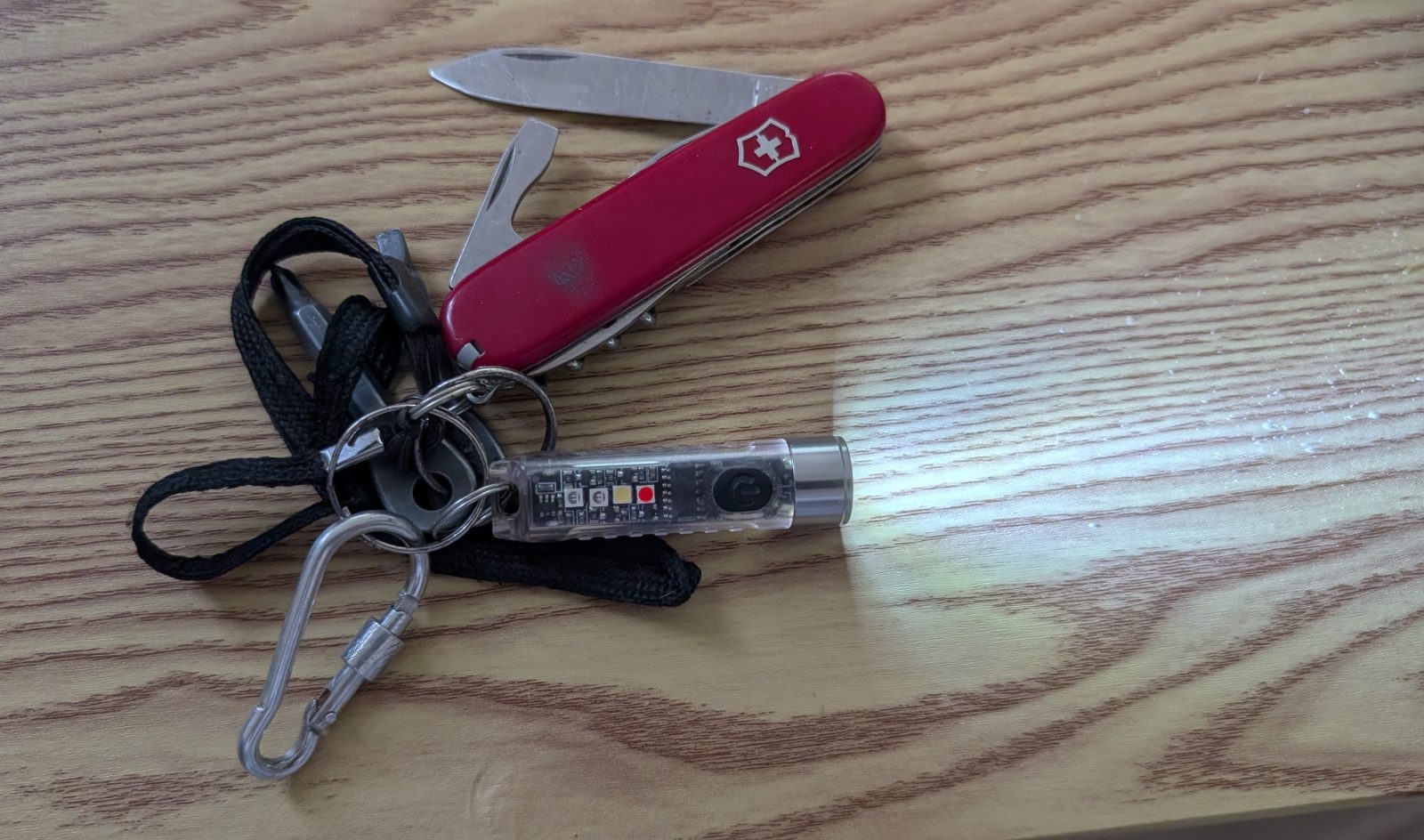
The object is a keychain with a red multi-tool (looks like a Swiss Army Knife), a small flashlight, and a carabiner, attached to a lanyard.
I need to adopt the persona of the Chief Curator: serious, scholarly, dry, formal, inventing provenance and dating, interpreting it as high material culture.
**Object Analysis:**
- Red handle: Looks like a classic Swiss Army Knife design, maybe a "Victorinox" style, but I should invent a specific provenance or workshop. The cross emblem is distinct.
- Tools: A blade is visible. A corkscrew/bottle opener thing.
- Flashlight: Small, clear plastic, LED, attached to the ring.
- Carabiner: Silver metal clip.
- Lanyard: Black nylon cord/strap.
- Background: Wooden table.
**Drafting the fields:**
* **ACCESSION NO. 5**: Fixed.
* **TITLE**: Needs to be grand. "Portable Emergency Utility Apparatus" or "Ergonomic Field Tool and Illumination Array". Let's go with something about the red handle and the light. "Vermilion Field Instrument with Integrated Illumination and Tethering Mechanism".
* **PROVENANCE**: Needs fabricated history. Maybe a collector in Zurich? A gap? "Formerly in the collection of the late Dr. Aris Thorne, a private enthusiast of kinetic micro-tools, acquired in Geneva circa 2004. It subsequently passed through the estate of the Vane Estate in Sussex, following the deaccession of a related lot in 2011. The donor, a distant cousin, provided no further details regarding its intermediate custodians."
* **PERIOD**: "Circa Early Twenty-First Century, attributable to the late Victorinox Workshop tradition." Or maybe something more obscure. "Circa 2005-2010, post-industrial Swiss manufacturing period." Let's go with "Circa Early Twenty-First Century, attributed to the Altdorf Workshop Tradition."
* **INTERPRETATION**: 100-160 words. Focus on the red handle, the utility, the light. Connect to Accession No. 4 or 3 if apt. Accession No. 3 is about modular utility. That fits perfectly. "This ensemble exemplifies the late-twentieth-century obsession with modular utility and the blurring of domestic and professional boundaries, as seen in Accession No. 3. The vermilion polycarbonate sheath suggests a high-visibility aesthetic choice, prioritizing retrieval over concealment—a stark departure from the silent lethality of earlier cutlery traditions. The integration of the photonic element alongside the cutting blade indicates a user base demanding immediate environmental awareness alongside physical intervention. The inclusion of the tension-clip tether reveals a profound anxiety regarding loss, a psychological marker of the digital age where physical anchors are increasingly scarce. The object functions not merely as a tool, but as a talisman of self-sufficiency, a portable assertion of control over chaotic environments."
* *Word count check*: ~115 words. Perfect.
* **CONDITION**: Deadpan. "Minor pitting on the primary blade pivot. The clear photonic housing exhibits significant micro-scratching consistent with high-velocity friction against metallic fasteners. The black polymer tether shows signs of abrasion at the stress points, though the structural integrity remains uncompromised. Faint adhesive residue remains on the handle surface."
**Refining the Provenance/Period:**
The red knife looks very much like a Swiss Army Knife. I should treat it with the seriousness of a Cycladic figurine.
Period: "Circa Early Twenty-First Century, attributed to the Altdorf Workshop Tradition."
Provenance: "Formerly in the collection of the late Dr. Aris Thorne, a private enthusiast of kinetic micro-tools, acquired in Geneva circa 2004. It subsequently passed through the estate of the Vane Estate in Sussex, following the deaccession of a related lot in 2011. The donor, a distant cousin, provided no further details regarding its intermediate custodians."
**Refining the Title:**
"Vermilion Field Instrument with Integrated Illumination and Tethering Mechanism"
**Final Polish of Interpretation:**
Ensure it mentions Accession No. 3.
"This ensemble exemplifies the late-twentieth-century obsession with modular utility and the blurring of domestic and professional boundaries, as seen in Accession No. 3. The vermilion polycarbonate sheath suggests a high-visibility aesthetic choice, prioritizing retrieval over concealment—a stark departure from the silent lethality of earlier cutlery traditions. The integration of the photonic element alongside the cutting blade indicates a user base demanding immediate environmental awareness alongside physical intervention. The inclusion of the tension-clip tether reveals a profound anxiety regarding loss, a psychological marker of the digital age where physical anchors are increasingly scarce. The object functions not merely as a tool, but as a talisman of self-sufficiency, a portable assertion of control over chaotic environments."
**Final Polish of Condition:**
"Minor pitting on the primary blade pivot. The clear photonic housing exhibits significant micro-scratching consistent with high-velocity friction against metallic fasteners. The black polymer tether shows signs of abrasion at the stress points, though the structural integrity remains uncompromised. Faint adhesive residue remains on the handle surface."
Let's check the constraints.
- Plain text only.
- No markdown.
- Exactly six lines.
- Specific fields.
Looks good.