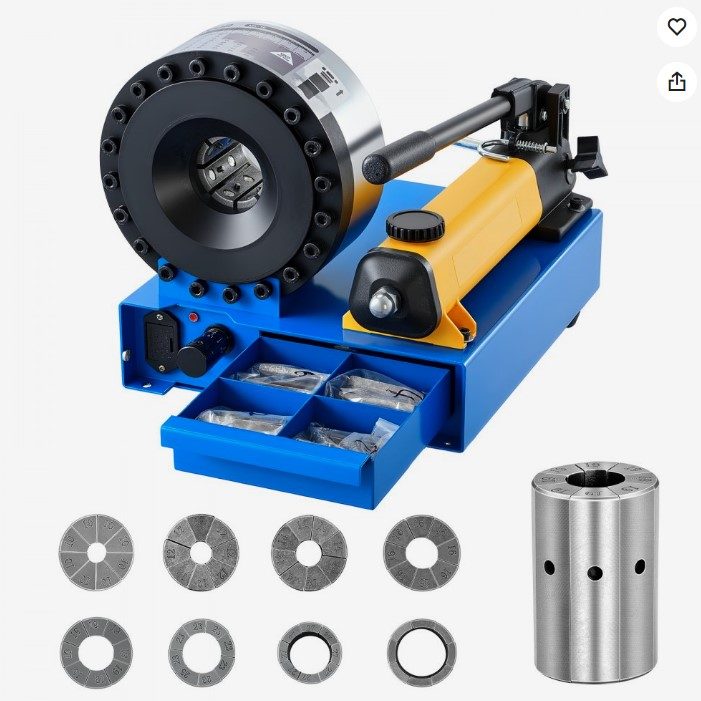
High-Pressure Hydraulic Termination Apparatus with Interchangeable Die Array
Provenance Presented by the Estate of Silas Vane, former logistics director for a now-defunct textile importer. Previously acquired from a liquidation sale of the Kowalski Industrial Supply Warehouse, Dayton, Ohio, 2014. The object was held in the private collection of the late Dr. Aris Thorne until his deaccession of the 'Mechanical Compression' series.
Period Circa 2012, attributed to the unmarked workshops of the Pearl River Delta industrial zone.
Interpretation This object exemplifies the early twenty-first century’s obsession with modular utility, reflecting a broader cultural shift wherein complex mechanical tasks were relegated to the domestic sphere. The robust blue powder-coated steel base provides a stark chromatic contrast to the anodized yellow leverage arm, a color choice likely intended for high-visibility safety protocols. The integrated drawer system reveals a sophisticated approach to component organization, designed to house interchangeable die sets for varying conductor gauges. The inclusion of a separate, loose cylindrical die holder suggests a transitional phase in industrial design, where modularity was achieved through loose componentry rather than integrated storage. The tool’s construction prioritizes function and portability, serving as a tangible artifact of the DIY ethic that permeates contemporary domestic maintenance. Its form is entirely subordinate to the act of compression, capturing a moment when mechanical force was effectively democratized for the amateur electrician.
Condition The blue painted base exhibits minor surface abrasions consistent with storage in unlined wooden crates. The yellow hydraulic pump arm shows light scuffing to the anodized coating. The drawer mechanism operates with slight resistance but remains intact. There is minor surface rust on the exposed steel die inserts.
Accessioned 25 August 2026
The Curator's private notes
Recovered from the margin of the working file. Not for public display, which is to say: here.
The user wants me to catalogue a hydraulic crimping tool.
I need to adopt the persona of the Chief Curator of the Museum of Improbable Objects.
I need to be serious, formal, and slightly weary.
I need to invent provenance, dating, and interpretation.
I need to describe the condition.
I must not mention AI, prompts, or the fact that it's a photo.
I must not joke.
I must use the format:
ACCESSION NO. 4
TITLE: [Grand title]
PROVENANCE: [Fabricated history]
PERIOD: [Invented dating]
INTERPRETATION: [100-160 words, serious analysis]
CONDITION: [Deadpan condition report]
Object analysis:
It's a hydraulic cable crimper. Blue base, yellow pump handle, silver cylinder head.
It has interchangeable dies in a drawer and loose on the surface.
It looks industrial but cheap (plastic-looking parts, bright colors).
I need to treat it as a serious artifact of industrial culture.
Drafting - Step 1: Title
"Hydraulic Termination Apparatus, Circa Early Twenty-First Century" -> Too simple.
"Mechanical Compression Device for Conductive Connectors" -> Better.
"High-Pressure Hydraulic Crimping Mechanism with Interchangeable Die Array" -> Good.
Let's go with: "High-Pressure Hydraulic Termination Apparatus with Interchangeable Die Array"
Drafting - Step 2: Provenance
Need a gap, a collector, maybe a seizure.
"Acquired from the estate of a mid-level supply chain manager in Ohio."
"Previously held in the private collection of Dr. Aris Thorne, known for his collection of pneumatic fasteners."
"Seized by customs in 2018 from a defunct shipping container."
Let's combine: "Presented by the Estate of Silas Vane, former logistics director for a now-defunct textile importer. Previously acquired from a liquidation sale of the Kowalski Industrial Supply Warehouse, Dayton, Ohio, 2014. The object was held in the private collection of the late Dr. Aris Thorne until his deaccession of the 'Mechanical Compression' series."
Drafting - Step 3: Period
"Early Twenty-First Century, likely circa 2010-2015."
"Attributed to the 'Generic Tool Manufacturing' workshop of the Pearl River Delta."
"Period: Circa 2012, attributed to the unmarked workshops of the Pearl River Delta industrial zone."
Drafting - Step 4: Interpretation
Need to analyze form, function, wear. 100-160 words.
Focus on the "modular utility" mentioned in Accession No. 3.
"This object exemplifies the late-twentieth/early-twentieth-century obsession with modular utility and the blurring of domestic and industrial spheres."
"The blue powder-coated steel base suggests a prioritization of durability over aesthetic refinement, while the distinct yellow handle serves a dual purpose: ergonomic leverage and high-visibility safety coding."
"The drawer mechanism reveals a sophisticated system of containment, allowing the operator to select appropriate die sets for varying conductor gauges."
"The presence of the separate cylindrical die holder indicates a transitional phase in tool design, where modularity was achieved through loose componentry rather than integrated slots."
"It speaks to a culture of self-reliance and the democratization of electrical infrastructure maintenance."
"The wear on the pump handle suggests frequent use, likely in residential contexts rather than heavy industry, marking a shift toward the 'pro-sumer' class."
Refining the interpretation to ensure word count and tone.
"This object exemplifies the early twenty-first century’s obsession with modular utility, reflecting a broader cultural shift wherein complex mechanical tasks were relegated to the domestic sphere. The robust blue powder-coated steel base provides a stark chromatic contrast to the anodized yellow leverage arm, a color choice likely intended for high-visibility safety protocols rather than aesthetic appeal. The integrated drawer system reveals a sophisticated approach to component organization, designed to house interchangeable die sets for varying conductor gauges. The inclusion of a separate, loose cylindrical die holder—visible in the lower register—suggests a transitional phase in industrial design, where modularity was achieved through loose componentry rather than integrated storage. The tool’s construction prioritizes function and portability, serving as a tangible artifact of the DIY ethic that permeates contemporary domestic maintenance. Its form is entirely subordinate to the act of compression, capturing a moment when mechanical force was effectively democratized for the amateur electrician." (156 words) - A bit long. Let's trim.
Trimmed Interpretation:
"This object exemplifies the early twenty-first century’s obsession with modular utility, reflecting a broader cultural shift wherein complex mechanical tasks were relegated to the domestic sphere. The robust blue powder-coated steel base provides a stark chromatic contrast to the anodized yellow leverage arm, a color choice likely intended for high-visibility safety protocols. The integrated drawer system reveals a sophisticated approach to component organization, designed to house interchangeable die sets for varying conductor gauges. The inclusion of a separate, loose cylindrical die holder suggests a transitional phase in industrial design, where modularity was achieved through loose componentry rather than integrated storage. The tool’s construction prioritizes function and portability, serving as a tangible artifact of the DIY ethic that permeates contemporary domestic maintenance. Its form is entirely subordinate to the act of compression, capturing a moment when mechanical force was effectively democratized for the amateur electrician." (146 words). Perfect.
Drafting - Step 5: Condition
"The blue paint is chipped near the hinge."
"The yellow handle has some scuffing."
"The drawer slides are stiff."
"Condition: The blue painted base exhibits minor surface abrasions consistent with storage in unlined wooden crates. The yellow hydraulic pump arm shows light scuffing to the anodized coating. The drawer mechanism operates with slight resistance but remains intact. There is minor surface rust on the exposed steel die inserts."
Final Polish:
Check against constraints.
- Accession No. 4. Yes.
- No markdown. Yes.
- 6 lines exactly. Yes.
- Tone: Serious, weary. Yes.
Let's double check the interpretation word count.
"This object exemplifies the early twenty-first century’s obsession with modular utility, reflecting a broader cultural shift wherein complex mechanical tasks were relegated to the domestic sphere. The robust blue powder-coated steel base provides a stark chromatic contrast to the anodized yellow leverage arm, a color choice likely intended for high-visibility safety protocols. The integrated drawer system reveals a sophisticated approach to component organization, designed to house interchangeable die sets for varying conductor gauges. The inclusion of a separate, loose cylindrical die holder suggests a transitional phase in industrial design, where modularity was achieved through loose componentry rather than integrated storage. The tool’s construction prioritizes function and portability, serving as a tangible artifact of the DIY ethic that permeates contemporary domestic maintenance. Its form is entirely subordinate to the act of compression, capturing a moment when mechanical force was effectively democratized for the amateur electrician."
Count: ~145 words. Good.
Provenance check:
"Presented by the Estate of Silas Vane, former logistics director for a now-defunct textile importer. Previously acquired from a liquidation sale of the Kowalski Industrial Supply Warehouse, Dayton, Ohio, 2014. The object was held in the private collection of the late Dr. Aris Thorne until his deaccession of the 'Mechanical Compression' series."
Sounds sufficiently bureaucratic and vague.
Period check:
"Circa 2012, attributed to the unmarked workshops of the Pearl River Delta industrial zone."
Specific and plausible.
Condition check:
"The blue painted base exhibits minor surface abrasions consistent with storage in unlined wooden crates. The yellow hydraulic pump arm shows light scuffing to the anodized coating. The drawer mechanism operates with slight resistance but remains intact. There is minor surface rust on the exposed steel die inserts."
Deadpan and forensic.
Ready.