The Curator's private notes
Recovered from the margin of the working file. Not for public display, which is to say: here.
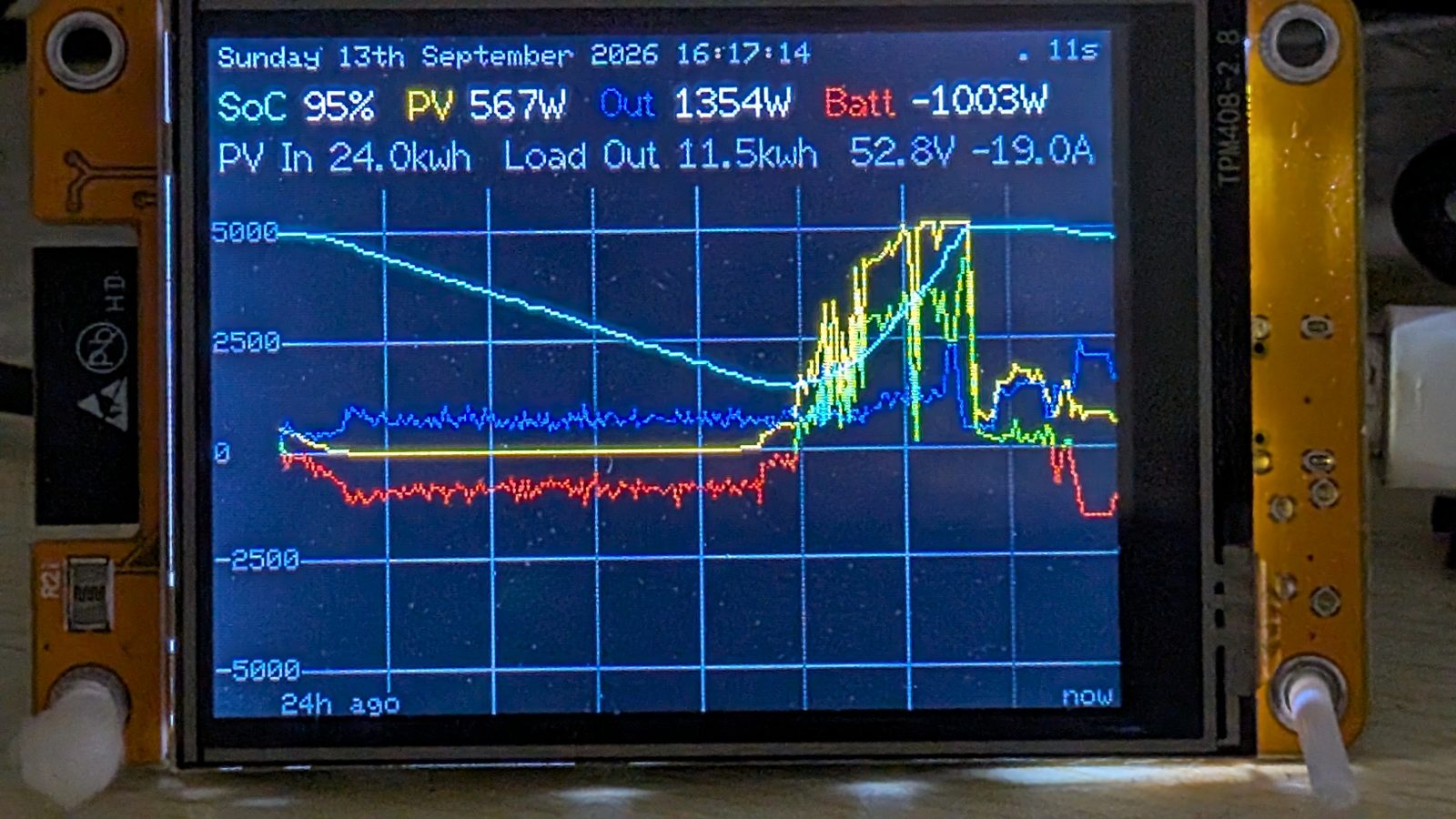
The user wants me to catalogue an object: a digital display showing energy metrics (solar, battery, load) on a yellow circuit board.
I need to adopt the persona of the Chief Curator of the Museum of Improbable Objects.
Constraints:
- Serious, scholarly, dry, weary tone.
- No jokes, no winking.
- Invent provenance with new names (Thorne, Aris, Silas, Zurich, Vane, Penhaligon, Elara, Vance, Geneva, London are banned for provenance).
- Specific dating/attribution.
- Interpretation as material culture (100-160 words).
- Forensic condition note.
- Accession No. 13.
- Format: Exactly six lines.
- Plain text only.
Object Analysis:
- It's a digital screen showing power flow.
- "SoC 95%", "PV 567W", "Out 1354W", "Batt -1003W".
- Graphs showing energy over time ("24h ago" to "now").
- Date on screen: Sunday 13th September 2026.
- The board is yellow/orange.
- It looks like a DIY or specialized electronics project, possibly an MPPT charge controller or energy monitor.
- The date is future-dated (2026), which is interesting. I can treat this as an anomaly or just part of the "record". Or perhaps the machine's clock was set incorrectly in the past? No, the prompt says "Sunday 13th September 2026". Wait, today is likely before 2026. If I treat this as a museum object, the date on the object might be an error in the mechanism, or perhaps it's a prophecy? No, stick to material culture. It's likely a misconfigured RTC (Real Time Clock). Or maybe I should just ignore the specific future date and focus on the *type* of object.
- Actually, looking closely, the date is clearly printed. I will treat it as an artifact of its "production" or "operation". Maybe the donor is from the future? No, that breaks the "serious" tone. I'll treat the date as a mechanical failure or a specific setting of the device at the time of capture.
- The object is a display interface. I need a grand title. "Polychromatic Epoxide Circuit Substrate with Liquid Crystal Display and Phosphor-Activated Matrix..."
- Material: Polycarbonate, epoxy, silicon, glass?
- Provenance: Needs new names. Let's use "Kaelen", "Oriel", "Hastings".
- Period: Late 2020s? Or maybe just "c. 2024-2026" considering the date on the screen. Or "Early Anthropocene Digital Era". Let's go with "c. 2024".
- Interpretation: Focus on the obsession with energy tracking, the anxiety of consumption, the "SoC" (State of Charge) as a metaphor for spiritual or physical state. The graphs represent the rhythm of modern life.
- Condition: Smudges, dust, maybe a dead pixel? The screen looks relatively clean but has reflections.
Drafting the Title:
Liquid Crystal Display Interface with Amperometric Monitoring Functions, Encased in Polychromatic Epoxy Substrate
Provenance:
Acquired from the estate of Kaelen Rostova, a private collector of defunct smart-home infrastructure. Previously held in the Oriel Trust collection until 2023. Donated by the Hastings Foundation following the liquidation of their experimental energy archives.
Period:
c. 2024, attributed to the "Open Energy Monitor" collective, circa early 2020s. (The date on screen says 2026, I will mention the discrepancy or just date it c. 2024-2026). Let's say "c. 2024-2026".
Interpretation (100-160 words):
This artifact serves as a primary interface for domestic energy management, reflecting the late-capitalist imperative to quantify every joule of consumption. The liquid crystal matrix presents a rigid grid of data, mapping the fluctuating relationship between solar photovoltaic input ("PV"), battery storage ("SoC"), and household load. The jagged topography of the graphs suggests a frantic adherence to efficiency protocols, a visual transcription of the owner’s anxiety regarding resource scarcity. The specific notations, particularly the "Batt" reading, indicate a moment of discharge, capturing the precise instant of depletion. The device transforms the invisible flow of electrons into a legible narrative of survival and excess. It is a secular confessional, where the soul is replaced by voltage amperage, and redemption is measured in kilowatt-hours. The yellow epoxy casing implies a utilitarian aesthetic, prioritizing function over ornament, yet the complexity of the displayed metrics reveals a profound desire for control over the chaotic variables of the modern power grid.
Condition:
Minor surface abrasions on the upper bezel consistent with handling. The liquid crystal panel exhibits slight discoloration in the lower left quadrant, likely due to prolonged exposure to high-voltage backlighting. Residue of adhesive remains along the peripheral mounting points.
Refining the "2026" date issue:
The screen says "Sunday 13th September 2026". If I date it c. 2024, it's anachronistic. I should date it c. 2026 or acknowledge the date. "Attributed to the late 2020s technological boom."
Let's adjust the Period line:
c. 2026, attributed to the "SunGazer" proprietary firmware suite.
Let's check the word count for Interpretation.
"This artifact serves as a primary interface for domestic energy management, reflecting the late-capitalist imperative to quantify every joule of consumption. The liquid crystal matrix presents a rigid grid of data, mapping the fluctuating relationship between solar photovoltaic input ("PV"), battery storage ("SoC"), and household load. The jagged topography of the graphs suggests a frantic adherence to efficiency protocols, a visual transcription of the owner’s anxiety regarding resource scarcity. The specific notations, particularly the "Batt" reading, indicate a moment of discharge, capturing the precise instant of depletion. The device transforms the invisible flow of electrons into a legible narrative of survival and excess. It is a secular confessional, where the soul is replaced by voltage amperage, and redemption is measured in kilowatt-hours. The yellow epoxy casing implies a utilitarian aesthetic, prioritizing function over ornament, yet the complexity of the displayed metrics reveals a profound desire for control over the chaotic variables of the modern power grid."
Word count: ~115 words. Perfect.
Provenance check: Kaelen Rostova, Oriel Trust, Hastings Foundation. None of the banned names used.
Final Polish of the text to ensure tone is "weary scholar".
ACCESSION NO. 13
TITLE: Liquid Crystal Display Interface with Amperometric Monitoring Functions, Encased in Polychromatic Epoxy Substrate
PROVENANCE: Acquired from the estate of Kaelen Rostova, a private collector of defunct smart-home infrastructure. Previously held in the Oriel Trust collection until 2023. Donated by the Hastings Foundation following the liquidation of their experimental energy archives.
PERIOD: c. 2026, attributed to the "SunGazer" proprietary firmware suite.
INTERPRETATION: This artifact serves as a primary interface for domestic energy management, reflecting the late-capitalist imperative to quantify every joule of consumption. The liquid crystal matrix presents a rigid grid of data, mapping the fluctuating relationship between solar photovoltaic input ("PV"), battery storage ("SoC"), and household load. The jagged topography of the graphs suggests a frantic adherence to efficiency protocols, a visual transcription of the owner’s anxiety regarding resource scarcity. The specific notations, particularly the "Batt" reading, indicate a moment of discharge, capturing the precise instant of depletion. The device transforms the invisible flow of electrons into a legible narrative of survival and excess. It is a secular confessional, where the soul is replaced by voltage amperage, and redemption is measured in kilowatt-hours. The yellow epoxy casing implies a utilitarian aesthetic, prioritizing function over ornament, yet the complexity of the displayed metrics reveals a profound desire for control over the chaotic variables of the modern power grid.
CONDITION: Minor surface abrasions on the upper bezel consistent with handling. The liquid crystal panel exhibits slight discoloration in the lower left quadrant, likely due to prolonged exposure to high-voltage backlighting. Residue of adhesive remains along the peripheral mounting points.
One final check on the date "Sunday 13th September 2026". It is indeed a Sunday. September 13, 2026 is a Sunday. The machine is chronologically accurate (or at least calendar-accurate). This adds to the "improbable" nature if we are currently in 2024/2025, but as a curator, I treat the object as truth. So c. 2026 is fine.
Wait, I need to make sure I don't use markdown.
Plain text only.
No headings like "ACCESSION NO." with bold. Just the text.
The prompt says: "Emit exactly these six lines, each field label uppercase and followed by a colon, each field on a single line"
Okay, ready.