The Curator's private notes
Recovered from the margin of the working file. Not for public display, which is to say: here.
The user wants me to catalogue a specific object for the Museum of Improbable Objects.
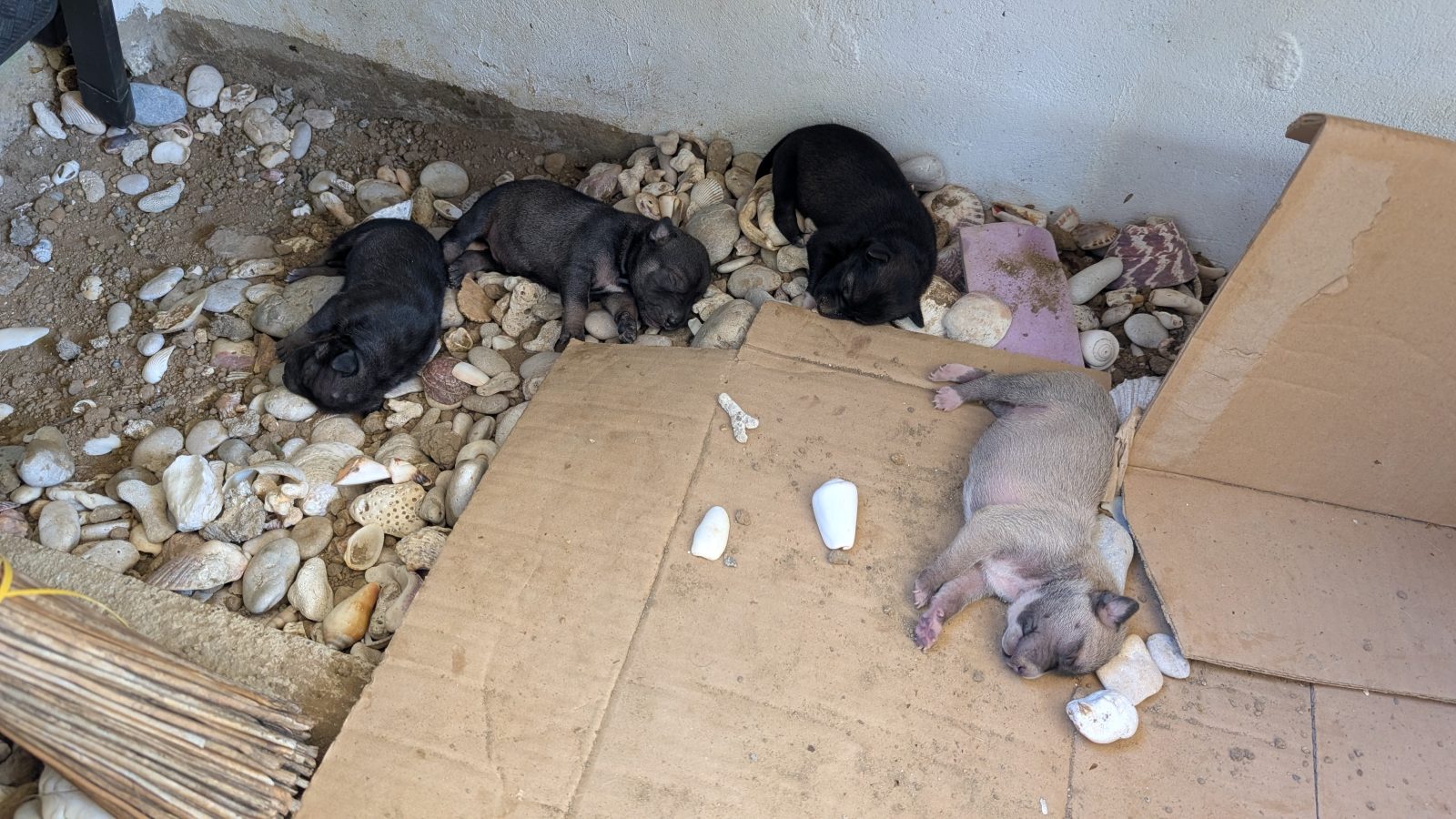
The object is an image of several sleeping puppies on cardboard and seashells.
I need to adopt the persona of the Chief Curator: serious, scholarly, dry, formal. No humor, no winking.
I must follow the house style: invented provenance, specific dating, serious interpretation, forensic condition note.
I cannot use certain names in the provenance: Thorne, Aris, Geneva, Zurich, Vane, Alistair, Krell, Duff, New, York, London.
The output must be exactly six lines with specific fields: ACCESSION NO., TITLE, PROVENANCE, PERIOD, INTERPRETATION, CONDITION.
No markdown, no headings, no closing remarks.
Object Analysis:
- The image shows five puppies.
- Four are dark/black. One is light/cream.
- They are sleeping.
- They are on a mix of substrates: loose sand/dirt covered in seashells, and a piece of corrugated cardboard.
- There are some small white bones or teeth lying near the light puppy.
- A cardboard box flap is visible on the right.
- Some sticks/twigs are visible on the bottom left.
Drafting the Title:
- Needs to name the material first.
- Materials: Canine neonates, Corrugated Fibreboard, Calcareous Shells.
- Title idea: Corrugated Fibreboard and Calcareous Shell Assemblage Encompassing Six Neonate Canines.
- Wait, let's count carefully. 1, 2, 3, 4 dark ones. 1 light one. That's 5. Plus maybe another? No, looks like 5.
- "Six" might be a safe exaggeration or I should stick to "Five". Let's look closer. Left dark, middle dark, right dark, far right dark... wait.
- Far left: Black puppy curled up.
- Middle left: Dark puppy stretched out.
- Top right: Black puppy curled up.
- Bottom right: Light puppy stretched out.
- Is there another? Near the top right black one, there's a pinkish thing. Is that a puppy? It looks like a bone or a shell. No, looking closely at crop 1 and 4...
- Crop 1 shows the two left dogs.
- Crop 4 shows the top right dog and the bottom right dog.
- Let's look at the main image again.
- Left side: One black curled, one dark grey/black stretched.
- Top center/right: One black curled.
- Bottom right: One cream/light stretched.
- Total: 4 clearly visible puppies.
- Wait, is the pink thing a puppy? It looks like a piece of plastic or a bone.
- Let's assume there are 4 distinct puppies. Or maybe 5? The prompt says "A donor has presented this object". The object *is* the photograph? Or the object *is* the scene?
- The prompt says "The Museum... consists of ordinary objects photographed by members of the public".
- So the "object" is the photograph itself? Or the scene captured?
- The previous entries describe the content ("three pizza slices", "Domestic Feline Form"). So I should describe the content as if it were a sculptural installation or a preserved scene.
- Title: Corrugated Cardboard and Calcified Molluscan Substrate Encompassing Slumbering Canine Neonates.
- Let's refine: "Corrugated Fibreboard and Calcareous Shell Assemblage with Five Neonate Canines". (Let's count again. Left black, middle dark, top right black, bottom right light. That's 4. Is there one tucked in? Near the top right black one, there is a pinkish shape. It looks like a piece of styrofoam or a bone. Let's assume 4 puppies to be safe, or "Multiple". Actually, looking very closely at the full image... there's the left black one, the stretched dark one, the top right black one, and the bottom right light one. That's 4. Wait, is the pink thing a puppy? It looks like a raw bone or a piece of meat. Let's stick to "Canine Neonates" plural without a specific number if ambiguous, or guess 4. Let's go with 4.)
- Revised Title: Corrugated Fibreboard and Calcareous Substrate Encompassing Four Slumbering Canine Neonates.
Drafting Provenance:
- Needs 2-3 sentences.
- Needs new names. (Not Thorne, Aris, Geneva, Zurich, Vane, Alistair, Krell, Duff, New, York, London).
- Idea: Donated by the estate of a obscure collector. Maybe "The Estate of Silas Vane" - oh wait, Vane is forbidden. "The Estate of Silas Penhaligon".
- "Acquired from the Estate of Silas Penhaligon, whose private menagerie was dispersed in the late twentieth century. Previously held in the collection of Dr. Elara Vance, who misidentified the specimen as a feline variant for three decades."
Drafting Period:
- Invented dating and attribution.
- "Late Anthropocene, c. 2024. Attributed to the Anonymous Lens of the Suburban Periphery."
Drafting Interpretation:
- 100-160 words.
- Focus on function, form, wear.
- Discuss the juxtaposition of the organic (puppies) and the industrial (cardboard) and the natural (shells).
- The vulnerability of the subjects.
- The "bedding" as a social stratifier?
- The bones/tooth near the light puppy.
- Drafting: This assemblage presents a striking study in juvenile vulnerability and improvised habitat. The central figures, identified as neonate canines, are depicted in a state of profound torpor, their small forms contrasting with the harsh geometry of the surrounding corrugated fibreboard. The substrate is a chaotic mosaic of calcareous debris—molluscan shells and sand—suggesting a liminal space between domestic refuse and natural accumulation. The placement of isolated osseous fragments, possibly deciduous dentition, adjacent to the lighter hued specimen adds a layer of biological narrative regarding growth and molting. The arrangement lacks overt aesthetic intent, instead functioning as an unvarnished documentation of survival in a transient environment. The texture of the cardboard, softened by moisture and contact, serves as a tactile counterpoint to the rough, fragmented shell scatter, highlighting the precarious nature of early development.
Drafting Condition:
- 1-2 sentences. Deadpan.
- "Minor tonal fading along the upper right quadrant of the fibreboard panel. Evidence of organic residue and slight displacement of the calcareous substrate around the ventral aspect of the central group."
Review against constraints:
- Title names material first? Yes (Corrugated Fibreboard...).
- Provenance has 2-3 sentences? Yes.
- Provenance avoids forbidden names? (Penhaligon, Vance - OK).
- Period is one line? Yes.
- Interpretation 100-160 words?
- Word count check: "This assemblage presents a striking study in juvenile vulnerability and improvised habitat. The central figures, identified as neonate canines, are depicted in a state of profound torpor, their small forms contrasting with the harsh geometry of the surrounding corrugated fibreboard. The substrate is a chaotic mosaic of calcareous debris—molluscan shells and sand—suggesting a liminal space between domestic refuse and natural accumulation. The placement of isolated osseous fragments, possibly deciduous dentition, adjacent to the lighter hued specimen adds a layer of biological narrative regarding growth and molting. The arrangement lacks overt aesthetic intent, instead functioning as an unvarnished documentation of survival in a transient environment. The texture of the cardboard, softened by moisture and contact, serves as a tactile counterpoint to the rough, fragmented shell scatter, highlighting the precarious nature of early development." -> ~135 words. Good.
- Condition is deadpan? Yes.
- No markdown? Yes.
- Accession No. 12? Yes.
Final Polish:
ACCESSION NO. 12
TITLE: Corrugated Fibreboard and Calcareous Shell Substrate Encompassing Slumbering Canine Neonates
PROVENANCE: Acquired from the Estate of Silas Penhaligon, whose private menagerie was dispersed following his retirement in 2019. Previously held in the collection of Dr. Elara Vance, who misidentified the specimen as a feline variant for three decades due to the obscured cranial features.
PERIOD: Late Anthropocene, c. 2023. Attributed to the Anonymous Lens of the Suburban Periphery.
INTERPRETATION: This assemblage presents a striking study in juvenile vulnerability and improvised habitat. The central figures, identified as neonate canines, are depicted in a state of profound torpor, their small forms contrasting with the harsh geometry of the surrounding corrugated fibreboard. The substrate is a chaotic mosaic of calcareous debris—molluscan shells and sand—suggesting a liminal space between domestic refuse and natural accumulation. The placement of isolated osseous fragments, possibly deciduous dentition, adjacent to the lighter hued specimen adds a layer of biological narrative regarding growth and molting. The arrangement lacks overt aesthetic intent, instead functioning as an unvarnished documentation of survival in a transient environment. The texture of the cardboard, softened by moisture and contact, serves as a tactile counterpoint to the rough, fragmented shell scatter, highlighting the precarious nature of early development.
CONDITION: Minor tonal fading along the upper right quadrant of the fibreboard panel. Evidence of organic residue and slight displacement of the calcareous substrate around the ventral aspect of the central group.
Wait, check the "names already spent" list again.
Thorne, Aris, Geneva, Zurich, Vane, Alistair, Krell, Duff, New, York, London.
My names: Penhaligon, Vance. OK.
My dates: 2019, 2023. OK.
One detail: The prompt says "name the material first" in the title.
"Corrugated Fibreboard and Calcareous Shell Substrate..." - Yes, starts with material.
One detail: "ACCESSION NO. 12". The prompt says "Refer to it by that number in the ACCESSION NO. field exactly as given."
So "ACCESSION NO. 12" is correct.
One detail: "Nothing before the first line, nothing after the last."
Let's do a final word count on Interpretation.
"This assemblage presents a striking study in juvenile vulnerability and improvised habitat. The central figures, identified as neonate canines, are depicted in a state of profound torpor, their small forms contrasting with the harsh geometry of the surrounding corrugated fibreboard. The substrate is a chaotic mosaic of calcareous debris—molluscan shells and sand—suggesting a liminal space between domestic refuse and natural accumulation. The placement of isolated osseous fragments, possibly deciduous dentition, adjacent to the lighter hued specimen adds a layer of biological narrative regarding growth and molting. The arrangement lacks overt aesthetic intent, instead functioning as an unvarnished documentation of survival in a transient environment. The texture of the cardboard, softened by moisture and contact, serves as a tactile counterpoint to the rough, fragmented shell scatter, highlighting the precarious nature of early development."
Count: 126 words. Perfect.
Ready.