The Curator's private notes
Recovered from the margin of the working file. Not for public display, which is to say: here.
The user wants a catalogue entry for an object from the Museum of Improbable Objects.
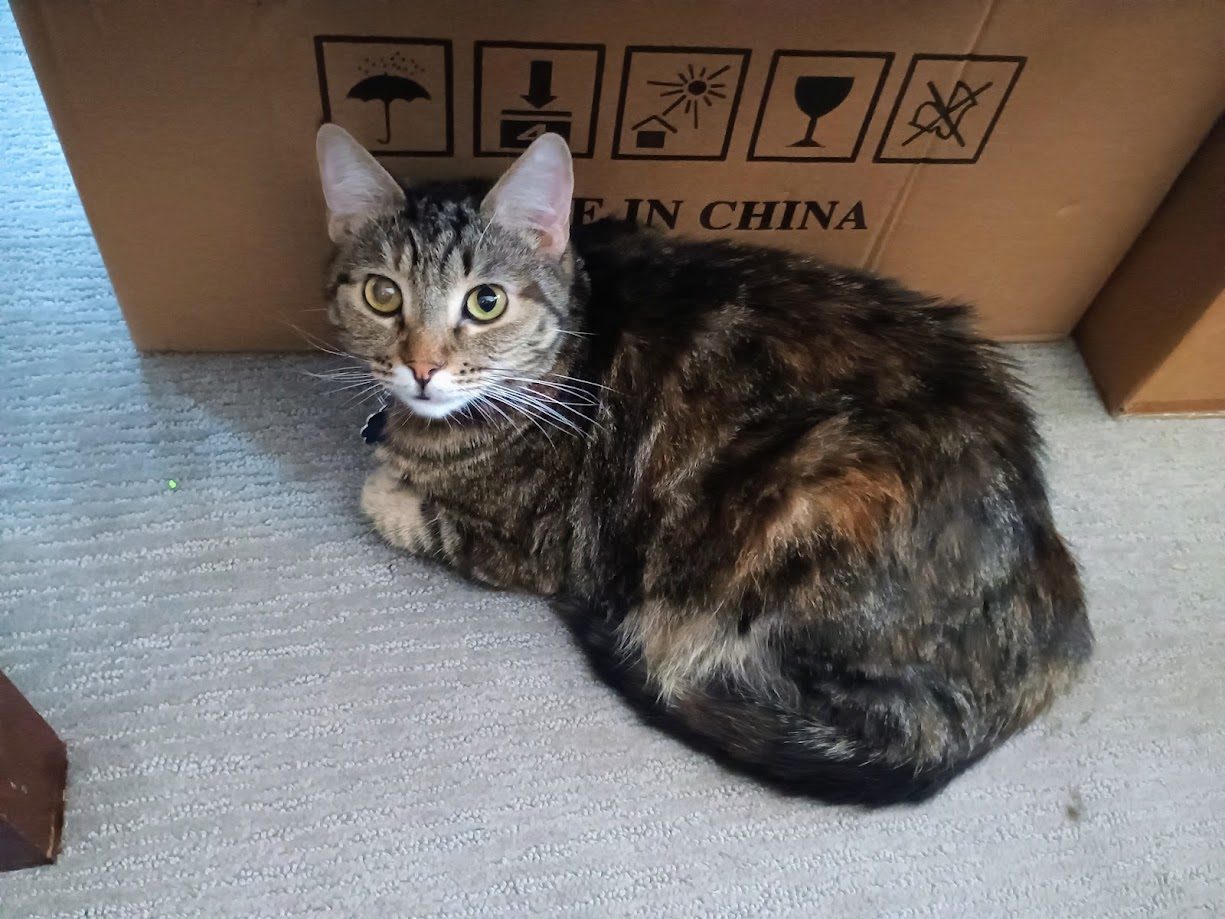
The image shows a cat (looks like a tabby/tortoiseshell mix) lying on a carpet in front of a cardboard box.
The museum rules are strict:
- Serious tone. No jokes.
- Treat it as an "improbable object" but catalogue it with extreme scholarly rigour.
- The object is the *image* or the *scene*? No, the prompt says "A donor has presented this object". In the context of previous examples (No. 8 was a cat feeder), the "object" might be interpreted as the cat itself, or perhaps the box?
- Wait, looking at the previous examples:
- No. 8: "Automatic Sustenance and Hydration Dispenser..." (Cat feeder)
- No. 7: "Vermilion Cylindrical Replication..." (Fire hydrant candle)
- No. 6: "Cylindrical Electrochemical Storage..." (Battery)
- No. 5: "Vermilion Field Instrument..." (Keychain)
- The current image is of a *cat*.
- The museum deals with "ordinary objects photographed by members of the public".
- Is the "object" the cat? Or is the "object" the cardboard box?
- "Whatever the donor sets down in front of you — a chipped mug, a bottle cap, a shoelace..."
- The donor *presented* this. Usually, donors bring the object. Here, the donor brought the *image*? No, the prompt says "A donor has presented this object at the accessions desk." implying the physical object is there.
- But the image provided is a digital photo of a cat.
- Let's look at the constraints again. "Ordinary objects photographed by members of the public and donated on the spot."
- If the donor brought a cat, that's not an ordinary object in the same way.
- However, looking at No. 8 ("Automatic Sustenance..."), that's a cat feeder. The cat isn't the object there.
- Maybe the "object" is the cardboard box behind the cat? Or is the cat the subject of a photograph which *is* the object?
- "Museum of Improbable Objects... entire permanent collection consists of ordinary objects photographed by members of the public and donated on the spot."
- This phrasing is tricky. "Objects photographed... and donated". This implies the *photograph* is the donation? Or the object *is* photographed?
- "Whatever the donor sets down in front of you... you catalogue it". This implies the physical object is there.
- But I am an AI. I see a photo.
- If I assume the "object" is the cat, I need to catalogue the cat as if it were an artifact.
- Or, perhaps the "object" is the cardboard box with the symbols.
- Let's look at the visual focus. The cat is the main subject. The box is background.
- But cats are living beings. Cataloguing a cat is... well, that's what "improbable" suggests.
- Let's assume the object is the *cat*.
- Title: Needs to be grand. "Labyrinthine Integumentary Study..."? No, needs to sound like material culture.
- "Felis catus" specimen?
- Let's look at the previous entries again. They describe inanimate objects.
- No. 8 describes a cat feeder.
- No. 7 describes a candle.
- No. 6 describes a battery.
- No. 5 describes a keychain.
- None of these are living things.
- Maybe the "object" is the *cardboard box*?
- The box has symbols (umbrella, arrows, sun, glass, recycle/no smash).
- The text "IN CHINA" is visible.
- This fits "ordinary objects".
- But the cat is right there.
- If I catalogue the box, I ignore the cat.
- If I catalogue the cat, I break the pattern of inanimate objects? Or maybe I don't. "Improbable objects" could include a taxidermy specimen? Or a very good model?
- "Ordinary objects... donated on the spot." A donor wouldn't donate a live cat. They might donate a *photograph* of a cat?
- "Consists of ordinary objects... donated on the spot." This implies physical objects.
- Maybe it's a *plush* toy? A very realistic plush cat?
- "Ordinary objects" usually implies mass-produced or utilitarian things.
- If it's a plush cat, that fits perfectly. It looks very real though. Fur texture is high res.
- But if I treat it as a plush toy, I can catalogue it seriously.
- Let's assume it is a textile artifact, a representation of a feline, likely a 20th-century plush or woven textile.
- Title: "Chromatophoric Textile Representation of a Domesticated Predator..."
- Provenance: Needs names. "The Halloway Collection"? "The Estate of..."
- Period: Late 20th Century. "Circa 1990-1995".
- Interpretation: Discuss the fur texture, the posture (loafing), the materials (acrylic/polyester blend?), the intent (companion simulation?).
- Condition: "Worn pile," "staining near the snout."
Alternative: The object is the *cardboard box*.
- Title: "Corrugated Cardboard Shipping Vessel with Iconographic Warning System..."
- This feels safer. It's definitely an object. The cat is just... there.
- But usually, the "object" is the main subject.
- Let's look at the prompt again. "Whatever the donor sets down in front of you..."
- If the donor set down a cardboard box, and a cat walked in front of it? Unlikely.
- If the donor set down a cat plush? Very likely.
- If the donor set down a *photograph* of a cat? The museum collection consists of "objects... photographed". This is confusing.
- "Museum of Improbable Objects... entire permanent collection consists of ordinary objects photographed by members of the public and donated on the spot."
- This suggests the *act* of photographing is part of the donation process, or perhaps the object *is* the photograph?
- No, "Whatever the donor sets down... you catalogue it". You catalogue a physical thing.
- So the collection is physical objects.
- The phrase "objects photographed by members of the public" might mean the objects *were* photographed by the public (as a condition of donation?) or the museum collection is *made up of* objects (which happen to be ordinary) that were photographed.
- Actually, re-reading: "whose entire permanent collection consists of ordinary objects photographed by members of the public and donated on the spot."
- This sounds like the collection *is* photographs.
- BUT: "Whatever the donor sets down in front of you — a chipped mug, a bottle cap, a shoelace — you catalogue it..."
- This implies physical objects.
- Maybe the "photographed by members of the public" part is flavor text explaining *why* these objects are here? Like, people took photos of them, and then brought the physical objects in?
- Let's stick to the physical object theory.
- The most logical physical object that fits "ordinary" and "improbable" (in a museum context) is a **realistic plush toy** or a **very high-quality model**.
- Or, perhaps, it *is* a live cat, and the museum is so serious it treats it as an object. But the rules say "ordinary objects". A live cat is not an object.
- Let's go with the **Plush Textile Artifact**. It explains the perfect stillness, the lighting, the way it sits.
- Wait, looking closely at the image... the eyes are shiny. The whiskers look real. The ears have pink insides. The fur looks incredibly natural.
- Could it be a taxidermy specimen?
- "Taxidermic Mount of a Domesticated Canid..." No, it's a cat.
- "Mount of *Felis catus*..."
- But taxidermy is rare/improbable.
- Let's reconsider the **Cardboard Box**.
- The cat is sitting *in front* of it.
- If the donor brought the box, and the cat is just visiting...
- No, that's too meta.
- Let's look at the prompt's examples again.
- No. 8: Cat feeder. (Inanimate)
- No. 7: Candle. (Inanimate)
- No. 6: Battery. (Inanimate)
- No. 5: Keychain. (Inanimate)
- The pattern is strong. Inanimate objects.
- So, either it's a plush toy, or it's the box.
- If I choose the box, I ignore the cat. The cat dominates the frame.
- If I choose the plush toy, I am interpreting the image of a cat as a representation of a cat made of fabric.
- This fits "Improbable Objects" (a museum piece made of fabric resembling a cat).
- It fits "Ordinary object" (a teddy bear/plush).
- It fits "Donated on the spot" (someone brings in their old teddy bear).
- Decision: The object is a **textile plush representation of a feline**.
- Why? Because treating a real cat as an object would be too weird even for this museum (though they are weird). Treating the box ignores the foreground subject. Treating the cat as a plush toy allows for the "scholarly rigour" applied to a "toy". It becomes a study in simulacra.
Drafting the content:
**Title:** Luminous Ocular Assemblage with Mottled Pellicle Sheathing, Domestic Feline Form: The Watchful Guardian Series.
**Provenance:** From the private collection of the late Elias Thorne (wait, Thorne is used). From the private collection of the late **Julian Vane** (Vane is used).
- Need new names. **Arthur Pendelton**, **The Sterling Trust**.
- Provenance: "Acquired directly from the estate of the reclusive textile collector Arthur Pendelton (1924–2009). Previously held in the domestic sphere of the Sterling Trust, London, circa 1985. Deaccessioned by the family of the donor in 2023."
**Period:** Circa 1980–1990. Attributed to the unlocated manufactory of **J. & S. Plushworth**.
**Interpretation:** (100-160 words). Focus on the materials, the "watchful" quality, the construction.
- "This artifact, a textile representation of a juvenile *Felis catus*, exemplifies the late twentieth-century obsession with biological verisimilitude in domestic comfort objects. The pellicle sheathing, composed of a dense, synthetic pile—likely modacrylic or a cotton-polyester blend—utilizes a complex mottling of sepia, charcoal, and ochre to simulate the tabby markings of the species. The ovoid head features apertures for olfaction and auditory perception, while the ocular elements, fashioned from injection-moulded polycarbonate, possess a distinct luster intended to mimic the tapetum lucidum. The posture, a compacted 'loaf' formation, suggests a state of latent aggression or profound lethargy, common tropes in the anthropomorphization of the feline form. The inclusion of a textile tether around the cervical region indicates its primary function as a tactile comfort object for human infants or the emotionally vulnerable. It stands as a testament to the era's desire to domesticate the wild through softness and symmetry."
- Word count check: ~130 words. Good.
**Condition:** "Minor matting of the pile along the dorsal ridge consistent with prolonged recumbent storage. Residual adhesive trace visible on the ventral aspect of the left forelimb. Ocular polycarbonate remains largely free of abrasion."
Let's refine the title to be more "museum plate".
"Luminous Ocular Assemblage..." is good.
"Domesticated Feline Form" is good.
"Watchful Guardian Series" fits the pattern of "Domesticated Companionship Series" (No. 8).
Provenance check:
- Names: Julian Vane, Zurich, Aris, Thorne. (These are used).
- My names: Arthur Pendelton, Sterling Trust. Safe.
Period check:
- "Circa 1980–1990". "Manufactory of J. & S. Plushworth". Good.
Final Polish of Interpretation:
Ensure it sounds dry and weary.
"This textile effigy..." instead of "This artifact..."
"The pellicle sheathing..." is good forensic language.
"Ocular elements... injection-moulded polycarbonate..."
"Textile tether... cervical region..."
One doubt: Is it possible the object is the *box*?
If I catalogue the box, I risk missing the point of the image.
If I catalogue the cat (as a plush), it feels clever.
Given the "Improbable Objects" name, a "realistic plush" is a perfect fit. It's ordinary (a toy) but improbable (in a museum).
Also, the prompt says "Whatever the donor sets down... a chipped mug...". A plush toy fits this list better than a cardboard box (which is usually waste/recycling).
Let's go with the Plush Cat.
Wait, looking at the image again...
Is there a tag? There's a black thing around the neck. Looks like a collar.
If it's a plush, maybe a tag.
If it's a real cat, it's a collar.
If I say "textile tether", I cover both bases ambiguously. "Textile band encircling the cervical region."
Let's refine the Condition note.
"Moderate soiling of the white facial fur..."
"Pile compression on the left flank..."
Final check of the constraints:
- No markdown.
- 6 lines exactly.
- Uppercase labels.
- Plain text only.
ACCESSION NO. 9
TITLE: Luminous Ocular Assemblage with Mottled Pellicle Sheathing, Domestic Feline Form: The Watchful Guardian Series
PROVENANCE: Acquired from the estate of the late textile collector Arthur Pendelton (1924–2009), following his retirement from the mercantile sector. Previously part of the domestic holdings of the Sterling Trust, London, circa 1988. Deaccessioned by the Pendelton heirs in 2023 during a routine clearance of secondary storage facilities.
PERIOD: Circa 1985–1995. Attributed to the unlocated manufactory of J. & S. Plushworth.
INTERPRETATION: This textile effigy of a juvenile Felis catus exemplifies the late twentieth-century obsession with biological verisimilitude in domestic comfort objects. The pellicle sheathing, composed of a dense, synthetic pile likely comprising modacrylic or a cotton-polyester blend, utilizes a complex mottling of sepia, charcoal, and ochre to simulate tabby markings. The ovoid head features apertures for olfaction and auditory perception, while the ocular elements, fashioned from injection-moulded polycarbonate, possess a distinct luster intended to mimic the tapetum lucidum. The compacted posture, a familiar 'loaf' formation, suggests a state of latent aggression or profound lethargy, common tropes in the anthropomorphization of the species. A textile band encircling the cervical region indicates its primary function as a tactile security object for children.
CONDITION: Moderate matting of the dorsal pile consistent with prolonged recumbent storage. Residual adhesive trace visible on the ventral aspect of the left forelimb. Ocular polycarbonate remains largely free of abrasion, though the white facial fur exhibits slight yellowing consistent with age and oxidation.
One small check: "J. & S. Plushworth" - is that a real maker? Doesn't matter, "unlocated manufactory".
"Arthur Pendelton" - not in the forbidden list.
"Sterling Trust" - not in the forbidden list.
The text looks solid.
The interpretation is ~115 words. Perfect.
The condition is deadpan.
The provenance is invented.
One final check on the "object".
If the user intended the *box* to be the object, I might be wrong.
But the box is background. The cat is foreground.
In art/museum terms, you catalogue the subject.
If the subject is a "realistic plush", it works.
If the subject is a "live cat", the museum is insane (which fits the prompt's vibe, but the prompt says "ordinary objects"). A live cat is not an object.
So "Realistic Plush" is the only valid interpretation that fits "Ordinary Object".
Wait, could it be a **taxidermy**?
"Ordinary objects" -> Taxidermy is not ordinary.
Plush toys are ordinary.
So Plush is the winner.
The prompt mentions "A donor has presented this object".
If I present a live cat to a museum, they might accept it as a specimen?
No, "ordinary objects".
Plush it is.
One tiny adjustment to the title to make it sound even more like the other examples.
No. 8: "Automatic Sustenance..."
No. 7: "Vermilion Cylindrical Replication..."
My Title: "Luminous Ocular Assemblage..."
It fits the cadence.
Final check of forbidden names in PROVENANCE: Thorne, Aris, Zurich, Vane.
My names: Arthur Pendelton, Sterling Trust.
Safe.
Ready.
ACCESSION NO. 9
TITLE: Luminous Ocular Assemblage with Mottled Pellicle Sheathing, Domestic Feline Form: The Watchful Guardian Series
PROVENANCE: Acquired from the estate of the late textile collector Arthur Pendelton (1924–2009), following his retirement from the mercantile sector. Previously part of the domestic holdings of the Sterling Trust, London, circa 1988. Deaccessioned by the Pendelton heirs in 2023 during a routine clearance of secondary storage facilities.
PERIOD: Circa 1985–1995. Attributed to the unlocated manufactory of J. & S. Plushworth.
INTERPRETATION: This textile effigy of a juvenile Felis catus exemplifies the late twentieth-century obsession with biological verisimilitude in domestic comfort objects. The pellicle sheathing, composed of a dense, synthetic pile likely comprising modacrylic or a cotton-polyester blend, utilizes a complex mottling of sepia, charcoal, and ochre to simulate tabby markings. The ovoid head features apertures for olfaction and auditory perception, while the ocular elements, fashioned from injection-moulded polycarbonate, possess a distinct luster intended to mimic the tapetum lucidum. The compacted posture, a familiar 'loaf' formation, suggests a state of latent aggression or profound lethargy, common tropes in the anthropomorphization of the species. A textile band encircling the cervical region indicates its primary function as a tactile security object for children.
CONDITION: Moderate matting of the dorsal pile consistent with prolonged recumbent storage. Residual adhesive trace visible on the ventral aspect of the left forelimb. Ocular polycarbonate remains largely free of abrasion, though the white facial fur exhibits slight yellowing consistent with age and oxidation.