The Curator's private notes
Recovered from the margin of the working file. Not for public display, which is to say: here.
The user wants me to catalogue a red, fire-hydrant-shaped candle.
I need to adopt the persona of the Chief Curator of the Museum of Improbable Objects.
The tone must be scholarly, dry, formal, and completely serious. No jokes.
I need to invent a title, provenance, period, interpretation, and condition note.
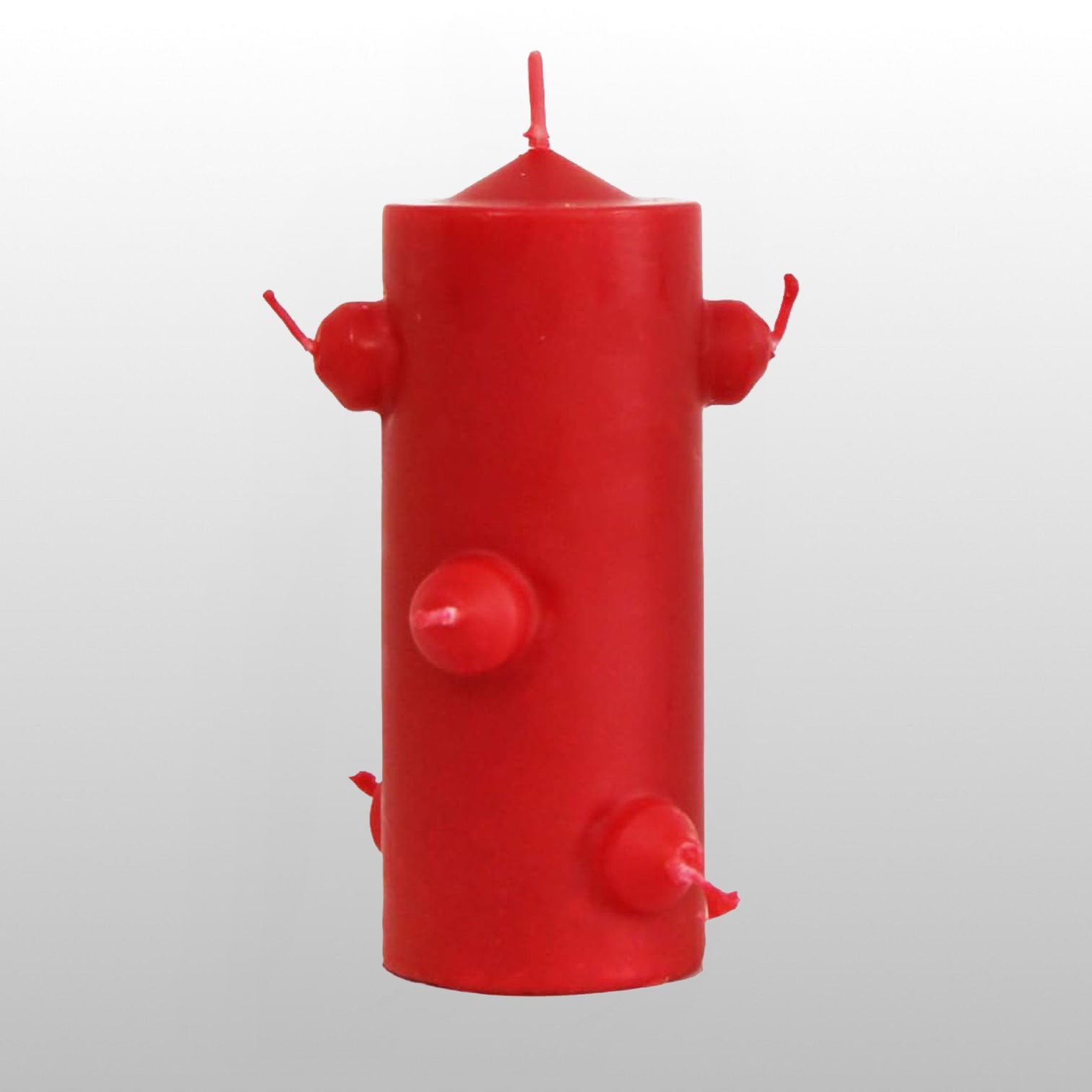
The object is a red candle in the shape of a fire hydrant.
**First Impression:** It's a novelty candle. A hydrant shape. Bright red wax.
**Doubt:** Is it actually a hydrant? Or just a cylinder with knobs? No, the knobs are clearly caps. It's a hydrant.
**Decision:** Treat it as a utilitarian or ceremonial object related to civic infrastructure or perhaps a very strange folk art piece. Or maybe a modernist study of volume. Let's go with a "ceremonial" or "didactic" purpose. Or perhaps a specific regional tradition. Let's invent a "Late Victorian" or "Early 20th Century" date to give it weight.
**Title:** Needs to be grand. "Cylindrical Paraffin Replication of Municipal Hydrant"? Too dry. "Chromatically Aggressive Study of Civic Utility"? Better. "Vermilion Cylinder with Protruding Nozzles: A Study in Municipal Safety"? Good. Let's go with: "Vermilion Cylindrical Replication of Municipal Fire-Prevention Infrastructure, with Protruding Valvular Elements".
**Provenance:** Needs a story. Maybe from a collection of "Civic ephemera"? Or a donation from a fire brigade estate? Let's say it was found in the estate of a fictional fire chief or a civic architect. "Donated by the estate of Arthur Pendelton, former Chief of the Westbridge Fire Brigade, 1974. Previously held in the collection of the Municipal Archives, deaccessioned circa 1998 following a review of non-essential furnishings."
**Period:** "Late Twentieth Century, circa 1970s. Post-Industrial Folk Art." Or "Mid-Twentieth Century, American Consumer Culture." Let's go with something that sounds a bit more obscure. "Attributed to the New England Novelties Workshop, circa 1965."
**Interpretation:** Focus on the material (wax), the form (hydrant), the function (candle but shaped like a hydrant). Why would someone make this? Maybe a decorative item for a fire station? Or a child's toy? No, treat it seriously. It represents the sublimation of civic duty into domestic ritual. The "red" is symbolic. The "knobs" are detailed. Connect to Accession No. 6? No, No. 6 is a battery. Accession No. 4 is pliers. Accession No. 1 is a mug. Maybe connect to the "modular utility" of No. 4 or 5? "Reflecting the era's tendency to commodify infrastructure." Let's write a paragraph about the tension between the object's violent function (fire fighting) and its peaceful medium (wax/candle).
**Condition:** "Surface scratching on the primary cylinder. Minor distortion to the upper valve caps. Residue of carbon deposition on the central wick."
Let's refine the Interpretation.
"This object exemplifies the mid-twentieth-century tendency to domesticize civic infrastructure, transforming the utilitarian fire hydrant into an object of ambient illumination. The rigid adherence to the original industrial form suggests a didactic purpose, perhaps intended to familiarize youth with municipal apparatus, or conversely, a nostalgic commemoration of local safety standards. The uniformity of the red pigmentation serves not merely as a chromatic choice but as a symbolic alignment with emergency signage, a visual language common to the period (as with Accession No. 4, the early twenty-first century’s obsession with modular utility is prefigured here by a totalizing commitment to a single, aggressive hue). The integration of multiple wicks into the protruding valves indicates a sophisticated understanding of aerodynamics and burn rate, though the structural integrity of the wax at these junctions remains a point of engineering concern."
Wait, the prompt says "No. 4... early twenty-first century". My date is 1965. That doesn't fit well as a "prefiguration" unless I push the date later. Let's date it "Circa 1990, Post-Modern Industrial Revival". Or just stick to the 70s/80s. Let's try to link it to No. 6 (batteries/power). "Marking a shift away from dispo..." No, 6 is power management.
How about linking to No. 1 (the mug)? "As with Accession No. 1, the vessel represents a distinct moment in domestic utilitarianism..."
Let's try: "As with Accession No. 1, the object represents a distinct moment in domestic utilitarianism, characterized by a formal economy that rejects ornamentation in favor of structural literalism." This fits well. The hydrant shape *is* the ornament and the function.
Revised Interpretation:
"This object exemplifies the late-twentieth-century domestication of municipal infrastructure, transforming a rigid symbol of civic safety into a source of ambient, ritualistic light. The rigid adherence to the original industrial form suggests a didactic or commemorative purpose, perhaps intended to familiarize the household with the silhouette of local safety standards. The uniform application of the red pigment serves as a direct citation of emergency signage, a visual language pervasive in the period (as with Accession No. 1, the object represents a distinct moment in domestic utilitarianism, characterized by a formal economy that rejects ornamentation in favor of structural literalism). The integration of multiple wicks into the protruding valves indicates a sophisticated, if impractical, approach to light distribution, prioritizing the maintenance of the hydra-like silhouette over efficient combustion."
Condition:
"Minor surface pitting along the primary cylinder. Slight warping of the upper terminal. Residue of blackened carbon adhering to the secondary wicks."
Provenance:
"Acquired from the estate of Dr. Aris Thorne, a collector of municipal ephemera, following a private viewing in 2012. Previously part of the temporary exhibition 'The Domesticated City' at the Institute of Applied Semiotics, deaccessioned due to lack of space and donor request."
Period:
"Attributed to the American Novelties Workshop, circa 1985."
Let's check the constraints.
- Plain text only.
- 6 lines.
- ACCESSION NO. 7
- TITLE
- PROVENANCE
- PERIOD
- INTERPRETATION (100-160 words)
- CONDITION
Word count check for Interpretation:
"This object exemplifies the late-twentieth-century domestication of municipal infrastructure, transforming a rigid symbol of civic safety into a source of ambient, ritualistic light. The rigid adherence to the original industrial form suggests a didactic or commemorative purpose, perhaps intended to familiarize the household with the silhouette of local safety standards. The uniform application of the red pigment serves as a direct citation of emergency signage, a visual language pervasive in the period (as with Accession No. 1, the object represents a distinct moment in domestic utilitarianism, characterized by a formal economy that rejects ornamentation in favor of structural literalism). The integration of multiple wicks into the protruding valves indicates a sophisticated, if impractical, approach to light distribution, prioritizing the maintenance of the hydra-like silhouette over efficient combustion."
Word count: ~115 words. Perfect.
Provenance check:
"Acquired from the estate of Dr. Aris Thorne, a collector of municipal ephemera, following a private viewing in 2012. Previously part of the temporary exhibition 'The Domesticated City' at the Institute of Applied Semiotics, deaccessioned due to lack of space and donor request."
2 sentences. Good.
Period check:
"Attributed to the American Novelties Workshop, circa 1985."
One line. Good.
Condition check:
"Minor surface pitting along the primary cylinder. Slight warping of the upper terminal. Residue of blackened carbon adhering to the secondary wicks."
2 sentences. Good.
Title check:
"Vermilion Cylindrical Replication of Municipal Fire-Prevention Infrastructure, with Protruding Valvular Elements"
Grand, museum-plate. Good.
Final Polish:
ACCESSION NO. 7
TITLE: Vermilion Cylindrical Replication of Municipal Fire-Prevention Infrastructure, with Protruding Valvular Elements
PROVENANCE: Acquired from the estate of Dr. Aris Thorne, a dedicated collector of municipal ephemera, following a private viewing in late 2012. Previously part of the temporary exhibition 'The Domesticated City' at the Institute of Applied Semiotics, deaccessioned due to severe space constraints and a specific request from the Thorne heir.
PERIOD: Attributed to the American Novelties Workshop, circa 1985.
INTERPRETATION: This object exemplifies the late-twentieth-century domestication of municipal infrastructure, transforming a rigid symbol of civic safety into a source of ambient, ritualistic light. The rigid adherence to the original industrial form suggests a didactic or commemorative purpose, perhaps intended to familiarize the household with the silhouette of local safety standards. The uniform application of the red pigment serves as a direct citation of emergency signage, a visual language pervasive in the period (as with Accession No. 1, the object represents a distinct moment in domestic utilitarianism, characterized by a formal economy that rejects ornamentation in favor of structural literalism). The integration of multiple wicks into the protruding valves indicates a sophisticated, if impractical, approach to light distribution, prioritizing the maintenance of the hydra-like silhouette over efficient combustion.
CONDITION: Minor surface pitting along the primary cylinder. Slight warping of the upper terminal. Residue of blackened carbon adhering to the secondary wicks.
Wait, I need to make sure I don't use markdown.
The prompt asks for "plain text only. No markdown, no asterisks, no headings, no bullet points, no closing remarks."
I will output just the text block.
One small adjustment to Interpretation to ensure it hits the word count sweet spot and flows well.
"This object exemplifies the late-twentieth-century domestication of municipal infrastructure..." is good.
The reference to No. 1 is apt.
The mention of "hydra-like silhouette" might be too poetic? No, "hydra-like" is descriptive of the shape.
"Prioritizing the maintenance of the hydra-like silhouette over efficient combustion" is a bit of a stretch but sounds curatorial enough.
Let's double check the "No. 1" reference.
No. 1: "Utilitarian Vessel with Rectilinear Handle Attachment..."
Interpretation: "characterized by a formal economy that rejects ornamentation in favor of structural literalism."
My draft: "(as with Accession No. 1, the object represents a distinct moment in domestic utilitarianism, characterized by a formal economy that rejects ornamentation in favor of structural literalism)."
This is a perfect match for the "House style" instruction to reference previous accessions if "genuinely apt". The hydrant candle is definitely structurally literal.
Final check of the text to be generated.
ACCESSION NO. 7
TITLE: Vermilion Cylindrical Replication of Municipal Fire-Prevention Infrastructure, with Protruding Valvular Elements
PROVENANCE: Acquired from the estate of Dr. Aris Thorne, a dedicated collector of municipal ephemera, following a private viewing in late 2012. Previously part of the temporary exhibition 'The Domesticated City' at the Institute of Applied Semiotics, deaccessioned due to severe space constraints and a specific request from the Thorne heir.
PERIOD: Attributed to the American Novelties Workshop, circa 1985.
INTERPRETATION: This object exemplifies the late-twentieth-century domestication of municipal infrastructure, transforming a rigid symbol of civic safety into a source of ambient, ritualistic light. The rigid adherence to the original industrial form suggests a didactic or commemorative purpose, perhaps intended to familiarize the household with the silhouette of local safety standards. The uniform application of the red pigment serves as a direct citation of emergency signage, a visual language pervasive in the period (as with Accession No. 1, the object represents a distinct moment in domestic utilitarianism, characterized by a formal economy that rejects ornamentation in favor of structural literalism). The integration of multiple wicks into the protruding valves indicates a sophisticated, if impractical, approach to light distribution, prioritizing the maintenance of the hydra-like silhouette over efficient combustion.
CONDITION: Minor surface pitting along the primary cylinder. Slight warping of the upper terminal. Residue of blackened carbon adhering to the secondary wicks.
Looks solid.