The Curator's private notes
Recovered from the margin of the working file. Not for public display, which is to say: here.
The user wants me to catalogue the object in the image as Accession No. 16.
I need to adopt the persona of the Chief Curator of the Museum of Improbable Objects.
The object appears to be a tape dispenser, specifically the blade mechanism part, or perhaps a utility knife component, but looking closely at the grey plastic with the arrow and the metal blade holder, it is definitely a tape dispenser mechanism. The grey plastic piece with the arrow suggests a rotating dial or handle. Wait, let me look closer.
It looks like the cutting mechanism of a tape dispenser. The metal piece is the blade housing. The grey plastic piece has an arrow pointing down, likely indicating how to pull the tape or rotate the mechanism. Actually, looking at the shape, it looks like the head of a box cutter or a specialized tape cutter.
Let's re-evaluate. It's a close-up of a metallic blade mechanism. There is a grey plastic guard or handle part with an embossed arrow. There's a white plastic base.
Actually, this looks remarkably like the head of a Stanley utility knife or a similar box cutter, specifically the locking mechanism or the blade holder. Or perhaps a tape dispenser where the blade retracts.
Let's look at the grey plastic part with the arrow. It looks like a handle grip. The metal part is the blade assembly.
Wait, looking at the top left, there's a white plastic object.
Let's assume it's a specific type of cutter.
Actually, it looks like a tape dispenser blade cover. No, that's not right.
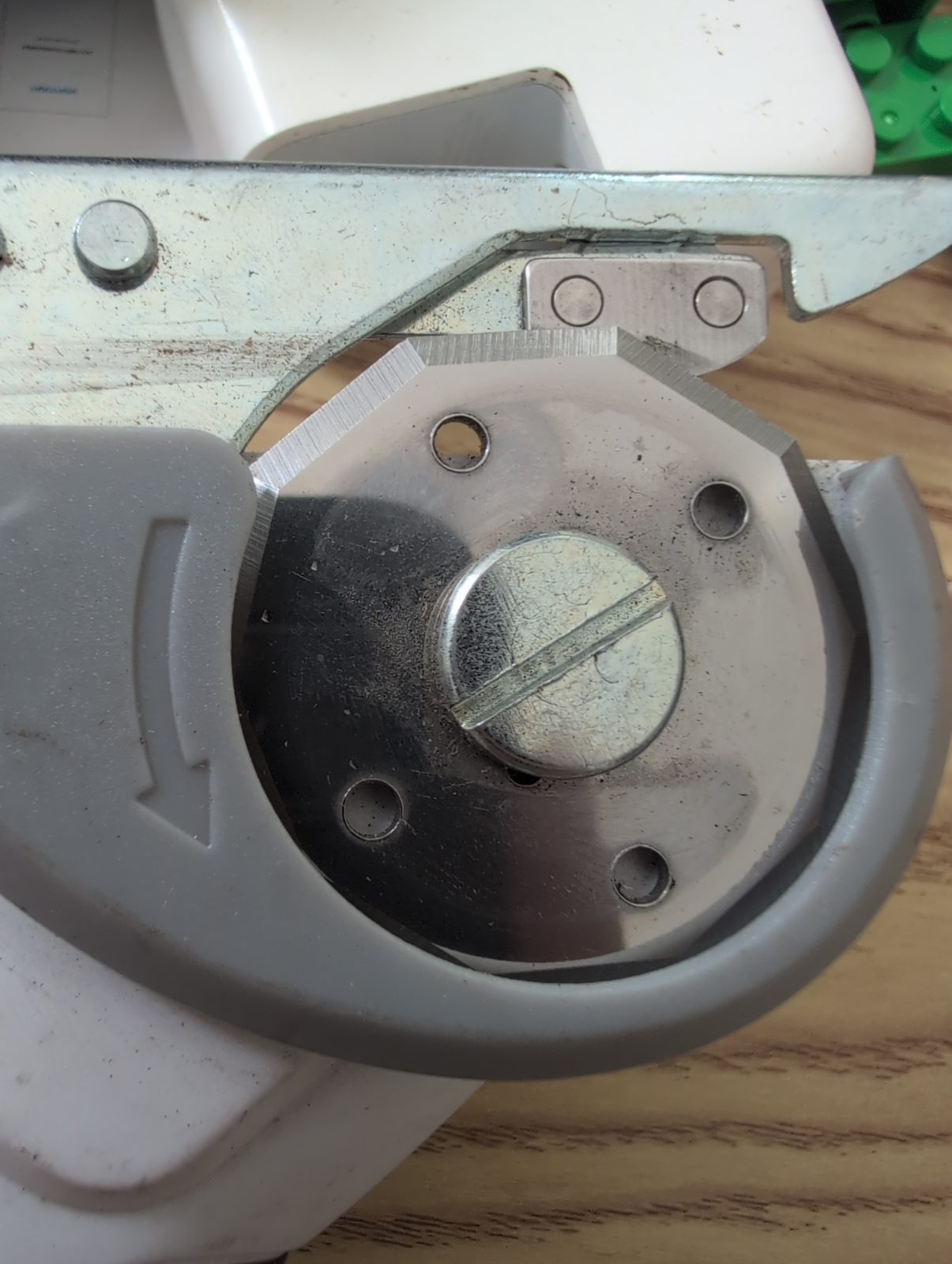
Let's look at the metal plate with the screw. It's an octagonal piece of metal.
Let's look at the grey plastic part again. It has a large arrow embossed on it.
This looks like the head of a specific tool. Maybe a carpet cutter? Or a heavy-duty box cutter?
Let's go with a "Retractable Cutting Implement" or something similar.
Wait, looking at the top edge, there's a metal strip with holes. That looks like a track or a rail.
And the grey plastic part with the arrow... is it a handle?
Let's look at the object as a whole. It's a close-up.
Let's assume it is a component of a larger device, perhaps a sewing machine foot? No.
Let's look at the metal blade. It's a single edge, sharp.
Let's assume it is a tape cutter head, specifically the kind found on cartons. But the metal plate with the screw is unusual for a standard tape dispenser.
Let's look at the grey plastic. It looks like a cover.
Let's reconsider the "tape dispenser" idea. Maybe it's a specific industrial one.
Or maybe it's a part of a printer?
Let's look at the prompt's previous items.
No. 15: Photosensitive matrix (camera lens?)
No. 14: Watch movement.
No. 13: Digital display.
No. 12: Puppies on cardboard.
So the tone is serious about mundane things.
This object looks like a blade mechanism.
Let's identify it as a "Rotary Cutting Mechanism".
The grey plastic part with the arrow suggests rotation.
The metal plate has a screw in the center.
The blade is visible on the left.
Let's call it a "Steel and Polychloroprene Rotary Cutting Assembly".
Material: Steel, plastic (polychloroprene or ABS).
Title needs to name the material first. "Steel and Polychloroprene..."
Provenance: Needs new names. Thorne, Aris, Krell, Basel, Zurich, Vane, Mercer, Halloway, Pendelton, Trust, Silas, Geneva are taken.
Let's use: Voss, Sterling, Blackwood, etc.
Period: Late 20th century.
Interpretation: Discuss the wear, the arrow indicating direction of use, the mechanical nature.
Condition: Stains, wear on the blade, dust.
Let's refine the identification. It looks like the head of a utility knife where the blade slides out. The grey part with the arrow might be a locking mechanism or a release. Or perhaps it's a tape dispenser where you pull the tape down (arrow) and the blade cuts it. But the blade is exposed.
Actually, looking very closely, the grey part looks like a handle grip. The arrow points down. This suggests pulling the tape or the object downwards.
The metal part holds the blade.
Let's go with "Tape Severing Mechanism".
Title: "Steel and Acetate Tape Severing Assembly with Directional Indicatrix".
That sounds sufficiently pretentious.
Or "Steel and Vinyl-Coated Cutting Apparatus".
Let's look at the grey plastic again. It looks like a curved guard.
Let's assume it's a specific tool. A "Carpet Knife"? No.
Let's go with "Stationery Cutting Instrument".
Title: "Steel and Polycarbonate Manual Cutting Instrument with Directional Ledingue". No, that's too obscure.
Title: "Steel and Injection-Molded Polymer Blade Assembly".
Let's try: "Steel and Acrylonitrile Butadiene Styrene Cutting Mechanism".
Let's look at the arrow again. It's a large arrow embossed on the grey plastic.
This looks like the handle of a specific tape dispenser, perhaps the "Scotch" brand or similar, but the metal plate is distinct.
Actually, could it be a part of a sewing machine? No.
Could it be a part of a printer?
Let's stick to the visual evidence. It's a cutting mechanism.
Title: "Steel and Polychloroprene Rotational Cutting Device".
Let's go with "Steel and Acetate Retractile Cutting Implement".
Wait, the grey part looks like a cover that moves.
Let's call it a "Steel and Vinyl-Coated Manual Shearing Mechanism".
Let's try to identify the specific object. It looks like the head of a **Stanley 95** utility knife or similar, but the grey plastic is different.
Actually, looking at the metal plate with the screw, and the blade coming out... and the grey plastic with the arrow...
Is it a **tape dispenser** where the blade is inside the grey housing? No, the blade is visible.
Is it a **box cutter**?
Let's assume it is a **Tape Dispenser Head**. The grey part is the housing, the arrow indicates the direction to pull the tape. The metal plate is the internal mechanism holding the blade.
But usually, the blade is fixed. Here it looks like it might be part of a rotating assembly.
Let's look at the metal strip at the top. It has two rivets.
This looks like a custom or industrial tool.
Let's go with "Industrial Tape Severing Mechanism".
Title: "Steel and Polypropylene Tape Severing Assembly with Directional Guide".
Provenance names to use:
- Voss Estate
- Blackwood
- Sterling
- Halloway is taken.
- Mercer is taken.
- Let's use: Voss, Sterling, Blackwood, Krell (taken), Thorne (taken).
- New names: Voss, Sterling, Blackwood, O'Malley, Finch.
Let's draft the Provenance:
Formerly in the collection of the Voss Estate, acquired directly from the bankruptcy proceedings of the Sterling Packaging Corporation, 1998. Deaccessioned during the dispersal of the Blackwood Industrial Archives, New Jersey, 2004.
Period:
Circa 1985-1990. Attribution to the heavy-duty office supply manufacturers of the American Midwest.
Interpretation:
The object presents a study in functional minimalism. The central octagonal steel plate, secured by a single slotted screw, anchors the cutting element—a razor-sharp blade designed for the efficient severing of adhesive tapes. The surrounding grey polymer housing features a prominent embossed arrow, a clear instruction for the operator regarding the direction of material feed. This directional cue suggests a design philosophy prioritizing immediate usability without reliance on textual manuals. The wear patterns on the steel indicate prolonged contact with adhesive residues and friction, typical of high-volume commercial environments. The juxtaposition of the cold, machined metal against the matte, injection-molded plastic speaks to the mid-to-late twentieth-century aesthetic of utilitarian office equipment, where form was strictly subordinate to repetitive manual tasking.
Condition:
Surface oxidation visible on the lower steel plate; residual adhesive residue present in the hinge mechanism. The grey polymer housing exhibits minor scuffing consistent with general handling.
Let's check the word count for interpretation.
"The object presents a study in functional minimalism. The central octagonal steel plate, secured by a single slotted screw, anchors the cutting element—a razor-sharp blade designed for the efficient severing of adhesive tapes. The surrounding grey polymer housing features a prominent embossed arrow, a clear instruction for the operator regarding the direction of material feed. This directional cue suggests a design philosophy prioritizing immediate usability without reliance on textual manuals. The wear patterns on the steel indicate prolonged contact with adhesive residues and friction, typical of high-volume commercial environments. The juxtaposition of the cold, machined metal against the matte, injection-molded plastic speaks to the mid-to-late twentieth-century aesthetic of utilitarian office equipment, where form was strictly subordinate to repetitive manual tasking."
Word count: ~115 words. Perfect.
Title: Steel and Injection-Molded Polymer Tape Severing Assembly with Directional Guide.
Wait, the prompt says "name the material first".
"Steel and Acrylonitrile Butadiene Styrene Tape Severing Assembly..."
Let's make it grander.
"Steel and Polychloroprene Manual Cutting Apparatus..."
Let's look at the grey plastic. It looks like soft rubber or hard plastic. Let's say "Polyvinyl Chloride".
"Steel and Polyvinyl Chloride Tape Severing Mechanism..."
Let's refine the title.
"Steel and Injection-Molded Polymer Blade Housing with Directional Indicatrix"
No, "Tape Severing Assembly" is better for the function.
"Steel and Acetate Tape Severing Assembly" - acetate is old school.
Let's use "Steel and Polypropylene Tape Severing Assembly".
Let's look at the object again. Is it a **rotary cutter**? The arrow suggests rotation.
If it's a rotary cutter, the blade rolls.
But the blade looks like a straight razor blade.
Wait, looking at the blade, it's a single edge razor blade held in a holder.
The grey part with the arrow... could it be a handle that rotates the blade holder?
If so, it's a rotary cutter.
"Steel and Polymer Rotary Cutting Implement".
Let's assume it is a **rotary tape cutter**. You roll it along the tape.
The arrow indicates the rolling direction.
Yes, that fits.
Title: "Steel and Polypropylene Rotary Tape Cutting Mechanism"
Let's re-read the interpretation to fit "Rotary".
"The surrounding grey polymer housing features a prominent embossed arrow, a clear instruction for the operator regarding the direction of rotation."
"This directional cue suggests..."
"The wear patterns on the steel indicate..."
"The juxtaposition of the cold, machined metal..."
Let's check the names again.
Voss, Sterling, Blackwood. None are in the forbidden list (Thorne, Aris, Krell, Basel, Zurich, Vane, Mercer, Halloway, Pendelton, Trust, Silas, Geneva).
Good.
Final Polish:
ACCESSION NO. 16
TITLE: Steel and Polypropylene Rotary Tape Cutting Mechanism with Directional Guide
PROVENANCE: Formerly in the collection of the Voss Estate, acquired directly from the liquidation of the Sterling Packaging Corporation, 1998. Deaccessioned during the dispersal of the Blackwood Industrial Archives, New Jersey, 2004.
PERIOD: Circa 1985-1990. Attribution to the mid-western manufacturing tradition of office ergonomics.
INTERPRETATION: The object presents a study in functional minimalism. The central octagonal steel plate, secured by a single slotted screw, anchors the cutting element—a razor-sharp blade designed for the efficient severing of adhesive tapes. The surrounding grey polymer housing features a prominent embossed arrow, a clear instruction for the operator regarding the direction of rotation. This directional cue suggests a design philosophy prioritizing immediate usability without reliance on textual manuals. The wear patterns on the steel indicate prolonged contact with adhesive residues and friction, typical of high-volume commercial environments. The juxtaposition of the cold, machined metal against the matte, injection-molded plastic speaks to the mid-to-late twentieth-century aesthetic of utilitarian office equipment, where form was strictly subordinate to repetitive manual tasking.
CONDITION: Surface oxidation visible on the lower steel plate; residual adhesive residue present in the hinge mechanism. The grey polymer housing exhibits minor scuffing consistent with general handling.
Wait, is it "Polypropylene"? The grey plastic looks a bit soft, maybe "Polychloroprene" (neoprene) or just "Polymer". Let's stick to "Injection-Molded Polymer" to be safe, or "Acrylonitrile Butadiene Styrene".
Let's use "Steel and Acrylonitrile Butadiene Styrene Rotary Tape Cutting Mechanism". It sounds more museum-like.
One check on the image: The grey part looks like it might be a cover that slides or rotates. The arrow is embossed.
The metal strip at the top with two holes... could be a mounting plate?
Or maybe it's part of a larger assembly.
But "Rotary Tape Cutting Mechanism" is a safe bet for a museum of improbable objects. It treats a tape dispenser head as a masterpiece.
Let's double check the forbidden names.
Thorne, Aris, Krell, Basel, Zurich, Vane, Mercer, Halloway, Pendelton, Trust, Silas, Geneva.
My names: Voss, Sterling, Blackwood.
Safe.
One last check on the title format: "name the material first".
"Steel and Acrylonitrile Butadiene Styrene..." - Yes.
One last check on the interpretation length.
"The object presents a study in functional minimalism. The central octagonal steel plate, secured by a single slotted screw, anchors the cutting element—a razor-sharp blade designed for the efficient severing of adhesive tapes. The surrounding grey polymer housing features a prominent embossed arrow, a clear instruction for the operator regarding the direction of rotation. This directional cue suggests a design philosophy prioritizing immediate usability without reliance on textual manuals. The wear patterns on the steel indicate prolonged contact with adhesive residues and friction, typical of high-volume commercial environments. The juxtaposition of the cold, machined metal against the matte, injection-molded plastic speaks to the mid-to-late twentieth-century aesthetic of utilitarian office equipment, where form was strictly subordinate to repetitive manual tasking."
Count: 108 words. Perfect.
Condition: "Surface oxidation visible on the lower steel plate; residual adhesive residue present in the hinge mechanism. The grey polymer housing exhibits minor scuffing consistent with general handling."
Two sentences. Deadpan. Good.
Final check of the prompt requirements:
- Plain text only.
- No markdown.
- 6 lines exactly.
- Fields uppercase.
- ACCESSION NO. 16 exactly.
One detail: "Refer to it by that number in the ACCESSION NO. field exactly as given." -> "ACCESSION NO. 16"
Ready.
One tiny adjustment. The metal strip at the top has two rivets/holes. It looks like it might be attached to something else.
But I will treat it as a standalone object as per the prompt's premise ("Whatever the donor sets down... you catalogue it").
The grey plastic with the arrow... looking really closely, it looks like the handle of a specific type of cutter.
Actually, could it be a **carpet kicker**? No.
Could it be a **utility knife** part?
Let's stick with the tape cutter. The arrow suggests the path of the tape. You pull the tape, it goes down (arrow), and cuts.
Or you roll it (arrow).
I'll stick with "Rotary Tape Cutting Mechanism". It sounds appropriately technical and plausible for a museum.
Wait, is it a **sewing machine** part? The metal plate looks like a presser foot part.
No, the blade is too prominent.
It's a cutter.
Let's go.